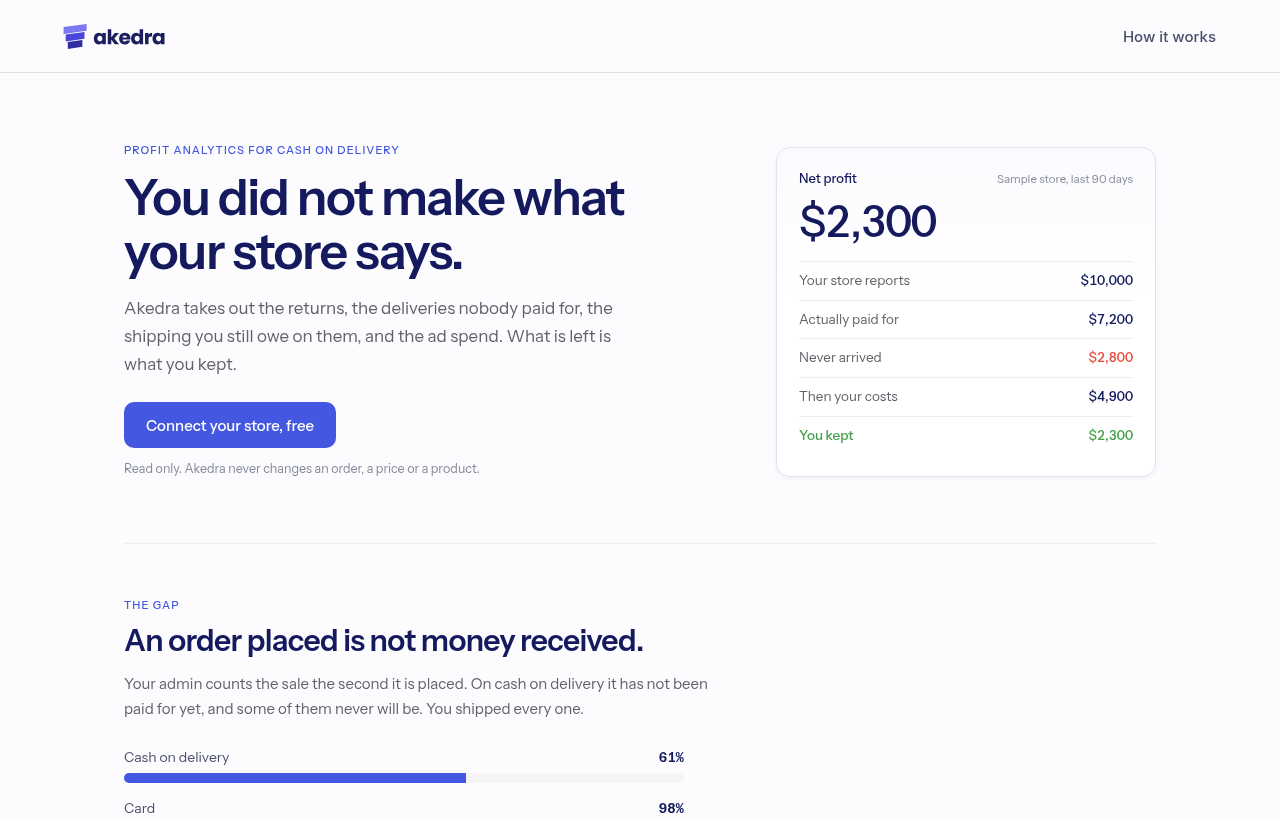
Akedra shows the profit your COD store actually keeps, after returns, failed deliveries, shipping, and ad spend.
- Focus
- Cash-on-delivery stores, MENA region
- Platforms
- Shopify, WooCommerce, BigCommerce
- How it connects
- Read-only, syncs via official platform APIs
- Pricing
- Free to connect. Paid plans not public yet.
Who it’s for
Cash-on-delivery ecommerce owners, mostly in the MENA region, running Shopify, WooCommerce, or BigCommerce, who suspect their real profit is lower than their sales dashboard says.
Where the money comes from
Cash on delivery breaks the normal rules of ecommerce accounting. A customer places an order, but the money is not real until a courier hands over the package and collects the cash, and a meaningful share of those orders never complete: the buyer refuses at the door, nobody is home, the package comes back. So a COD store's sales dashboard shows one number, "placed" revenue, while the cash that actually settles is something quite different, and the gap between them is where profit hides or disappears. Akedra exists to close that gap. It connects to a store, read-only, and shows the profit the business actually keeps once returns, failed deliveries, shipping, and ad spend are all accounted for.
What is sharp about it
The wedge is excellent, because the problem is real and specific. COD is huge across the MENA region and genuinely hard to measure, so a tool that tells a merchant their true per-product and per-channel profit is solving a problem those owners feel every month. A few choices stand out. It is read-only ("Akedra never changes an order, a price or a product"), which lowers the trust barrier for letting a new tool touch your store. It reports settlement rates by payment method, so a store can see how COD compares to card or a wallet like Whish. And when data is missing it shows a dash rather than a guess, which is a small thing that signals a lot: a profit tool that invents numbers is worse than useless, and Akedra pointedly refuses to.
How it makes money
This is one of the cases where the customer's money and the product's value are the same story. Akedra's whole job is to make or save its users money: by exposing which products and which channels actually keep cash, it lets a store kill the losers, the SKUs and campaigns that look fine on placed revenue but bleed out through returns and shipping. For a COD merchant, that is not a vanity dashboard, it is the difference between scaling a product that pays and pouring ad spend into one that does not.
For Akedra itself, the monetization is not public yet. Signup is free to connect, and paid plans are not stated on the site. The natural model for a read-only analytics tool like this is a subscription scaled to store size or order volume, but that is our read of the category, not something Akedra has published, so treat it as an open question rather than a fact.
The honest part
The product is clear and the problem is real. The hard part, as it is for almost every newer product built by a small team, is distribution: getting in front of exactly the COD merchants who need this, repeatedly, when the audience is still small. The narrowness that makes Akedra sharp also tells it exactly where to go, which specific communities, marketplaces, and merchant circles its buyers already sit in. That is the work that decides whether a good tool becomes a business, and it is the same lesson we come back to again and again in distribution beats product.
What a builder can learn
Akedra's biggest asset is how narrow it is. It is not "ecommerce analytics," it is profit analytics for cash-on-delivery stores in a specific region. A wedge that tight is easier to sell, easier to be trusted in, and easier to be found for than a general tool. The open question for a newer product with a small audience is not the product, it is distribution: getting in front of exactly those merchants, over and over.
Read: Pick a Narrow First Segment (Or Sell to Nobody)Is this your product?
Claim it to verify the details and, if you want, join The Builder Brief for breakdowns on getting customers.